Vancouver Whitecaps: The Airing of Grievances

If the Holiday period is about anything it’s about people arguing over petty differences while terrible atrocities happen in all four corners of the world.

But it’s also about judging other people in a harsh and unforgiving manner and so, with that in mind, this seems a good time to look at a few of the things that are most concerning about the current Vancouver Whitecaps.

A lot of these stem from a recent interview Carl Robinson gave to the AFTN podcast (and you can hear it here).

There were two ways of taking the entirety of what the coach said; you could either choose to see a man who was unphased by the pressures of the role and who had a firm grip on the tiller of the team or you could choose to see a man who failed to recognise the enormity of the task and who also failed to acknowledge just how bad his team were in 2016.

In the spirit of the season let’s adopt the latter approach for now.

Robinson certainly admitted that the season could have been better but he persisted in his view that the Whitecaps just weren’t that far away from being the finished article.

I guess that depends what the definition of the finished article is but Robinson’s contention that his team were maybe just two or three wins (or a couple of silly late goals) away from making the playoffs and therefore having a successful season sounds like three parts revisionism and two parts lack of ambition.

If the definition of success is a one game “play in” game on the road then that seems an awfully low bar to set.

Did the fact that Portland and now Seattle had won the MLS Cup put pressure on him? Seemingly not. Everything was as then as it is now in terms of pressure (he feels very little was the overarching feeling listening to him speak).

Now all of this could just be a coach being wary of what he said to the media but Robinson does seem to struggle in connecting to the fans (or some fans at least) when it comes to putting across just how much the game actually means.

But away from spurious speculation about the coach’s media motivation it was disconcerting to hear him say that any new players signed wouldn’t be there to block the path of the youngsters coming through the system.

Translation: “If we get the chance to sign somebody better than Marco Bustos we won’t do it”.

Now either that just isn’t true (I suspect it isn’t) or it’s a foolhardy way of bringing through young players.

Emerging players need to be challenged as they develop. Not given a free pass to the first team with all obstacles removed on the way.

Again we’re probably in the land of milquetoast media replies than anything else but it didn’t do anythng to quell the notion that the Whitecaps on the whole are happier with the status quo than they really should be.

Finally there’s the whole business of player recruitment.

We obviously don’t know the intricate details of how the club scout and sign players (this is MLS after all and sometimes I’m surprised they even release the results of games without some kind of obscure regulation being involved) but it does appear that Robinson himself is, by some distance, the main protagonist in deciding who to scout and who to sign.

That system works to a degree but it does mean that if he were to leave (for whatever reason) the Whitecaps will have almost zero continuity when it comes to acquisitions going forward.

If everybody in the squad is essentially a Robinson signing that creates an unwelcome dynamic for the next coach to come along.

It seems far better to make the business of bringing in players more centralised within the club than to trust it all to the man who is arguably (by the unwritten rules of soccer) the most ephemeral figure on the staff other than the people who actually get to kick a ball on match day.

Oh well. Hopefully this hasn’t been too downbeat for the festive season but worry not but because next time out we’ll look at the “Reasons to be Cheerful”.

A far merrier subject to be sure.
 

Killing time with speculation

One of the worst things about languishing in the purgatory of endlessly waiting for playoff games the Vancouver Whitecaps aren’t even involved in is the almost complete lack of any concrete news around the club.

And yet even in this barren wasteland of information there have been at least two possible transfer rumours alluding to a player heading to Vancouver (well maybe one and a half, or maybe just one, perhaps half a rumour at best).

Thankfully we are now living in a post-truth world so we can all pretty much speculate to our hearts content.

The most concrete (ish) rumour surrounds Robbie Keane

There are a few good reasons why Keane could come to the Whitecaps.

He and Carl Robinson became firm friends at Wolverhampton Wanderers when a freak training ground accident forced them to undergo a rarely attempted surgical procedure

robbokeane_620

And both players were said to be hugely relieved when the term “ballectomy” was fully explained to them.

Keane is a proven goalscorer in MLS and is the kind of experienced striker that Robinson has favoured in recent seasons.

Yet against all that stands the Irishman’s much professed hatred of turf and the fact that his salary would surely make him a no go if he was going to be used in the same manner as Earnshaw and Perez.

Robinson has a strange compulsion to sign players based on their impact on the locker room as much as the pitch but Keane would surely be a step too far in that direction.

So Keane to the Whitecaps? It’s less than likely.

The other rumour that swirled around social media recently was caused by this tweet

The LA Galaxy’s Emmanuel Boateng fits the Whitecaps model almost as much as Robbie Keane does.

He’s a quick wide player who doesn’t finish quite as well as he should but the Whitecaps have enough of those to be going on with unless there’s a trade involved somewhere.

The tweet was almost certainly a post-Trump joke rather than a declaration of intent but let’s run this idea passed the space-time continuum and see who tries to kill Hitler.

In 2017 Kekuta Manneh should be eligible for the US National Team and let’s assume he gets selected by whoever happens to be in charge at the time and then let’s further assume he has one of those games where he ends a couple of those runs of his with a goal.

Suddenly there’s a new young superstar on the US team and if there’s one thing the MLS media love it’s an exciting young American player and if there’s one thing that marketing departments of teams love it’s a player who gets media coverage.

To cut a long story short there’s a possibility that Manneh could be the Whitecaps hottest property by some distance next season.

Would MLS love to have such a player on an American team? Sure. Would they be prepared to give the Whitecaps something substantial in return? Sure.

Obviously I’m using “substantial” in the MLS sense of “completely imaginary  money” but it’s real if you think it’s real.

So Boateng to the Whitecaps? No, unless somewhere down the line the planets align to make the Galaxy yearn for the marketing muscle of Manneh.

Stranger things are happening every day.

The Laba Conundrum

Time for a tactical thought experiment in the mental laboratory (or should that be the Laba-ratory?).

No don’t stop reading now! It gets better! (Spoiler alert: It really doesn’t).

Matias Laba wasn’t alone in underperforming for the Vancouver Whitecaps in 2016 but it could be argued that his underperformance hurt the team most of all.

In the previous seasons Laba had been both a shield and midfield destroyer for the team and the absence of those qualities played no small part in the dreadful defensive performance of 2016.

But the kind of player Laba is offers its own problems for Carl Robinson.

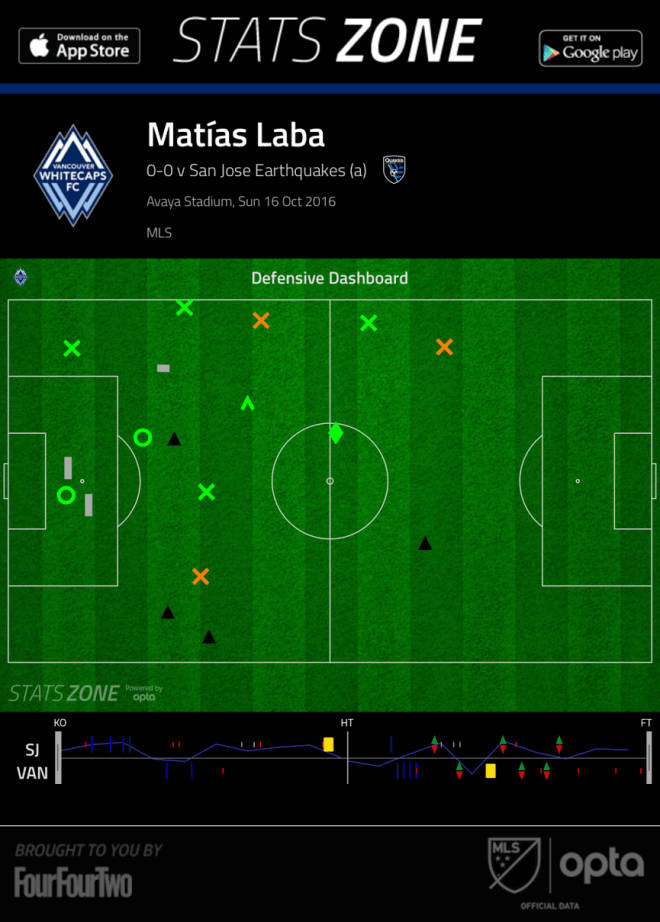
Take a look at these two shots of his defensive performance against Seattle and San Jose at the tail end of the season

laba-seattle

laba-san-jose

Laba may be a defensive midfielder but he’s not a holding midfielder. He doesn’t just sit in front of the back four protecting them because his game is about following the ball.

Perhaps the player Laba most resembles (in style if not in quality) is N’Golo Kanté the former Leicester and now Chelsea midfielder.

Like Laba, Kanté is about chasing down the opposition rather than waiting for them to come to him and he was hugely successful playing that style with Leicester and is developing similar success this year with Chelsea.

So what can the Whitecaps learn about the way Kanté has been used to get the best out of Laba? There are probably three main options.

Kanté worked for Leicester because they were primarily a counter attacking team and his ability to break up play was invaluable in such a system. But this was reliant on there always being defensive cover for Kanté no matter where he was on the field (usually Danny Drinkwater).

Of course Laba was equally successful last season in a counter attacking team because he had Gershon Koffie to cover for him.

So one option is for the Whitecaps to revert to what they were good at; put Jacobson, Teibert or McKendry alongside Laba and hope that a new number ten and a new striker are more capable of breaking down packed defences than the team were at the tail end of 2015.

Kanté’s success at Chelsea is partly because he has Matic as defensive cover and partly because Chelsea have now adapted to play three central defenders.

So Kanté can wander wherever he needs to because the middle of the pitch is always covered.

Playing three central defenders would solve one of Carl Robinson’s major selection headaches and allow him to field all three of Waston, Parker and Edgar (and the current backups of Dean and Seiler are more than adequate for MLS).

He also has the players to play as more attacking wing backs in Harvey and Levis on the left and Aird on the right (although an upgrade and cover on the right certainly wouldn’t hurt).

Again this would eliminate the need for a “box to box” midfielder and make the acquisition of a number ten and a striker the sole priorities.

The third option is to not use Laba at all.

Despite a poor season he’s still highly thought of in MLS and there would no shortage of teams willing to trade.

So cashing in on Laba and (hopefully) finding a central midfielder who can chip in with six or more goals a season and add a much needed attacking string to the Whitecaps’ bow isn’t an impossible dream.

The best option of these three?

That entirely depends on how Carl Robinson wants his team to play but the very worst thing he could do is to ignore the type of player Laba actually  is and leave both him and the team caught between the rock of a misused DP and the hard place of carelessly wasted salary spending.


Whitecaps extend Carl Robinson’s tenure

The news that Carl Robinson has signed a new contract with the Whitecaps through 2020 is both a huge vote of confidence in him from the Front Office and an attempt to imbue some stability at the club.

But stability isn’t the be all and end all of what a team should be; there has to be progress too and that was the missing element this year for the Whitecaps.

So if Carl Robinson were to give me a call and say “Russell, I need five bullet points on how to to improve in 2017. Can you help me?” I would say “Hey Carl! No I most definitely can’t because I’m an idiot but that’s a great idea for a really simple blog piece. Thanks!”.

And so we leave the coach staring disconsolately at his phone while we list five hastily thought through areas of possible development for the man in charge.

  • Better targeted signings– In other words bringing in players who fit a specific system rather than bringing in players just because they are “good”. File Kudo in that category and maybe even Perez too. Robinson probably got lucky with his early moves and unlucky with his later ones but finding pieces for the gaps rather than pieces that need a gap creating for them has to be the priority now.
  • Better in game management- Did I say “better”? Maybe I meant “braver”? Because there’s definitely a cautious side to Robinson that while having some advantages frequently limits his ability to change a game. Make an early substitution every now and then if only to keep the Whitecaps players on their toes. Change things around at half time if they aren’t going well. More active touchline coaching wouldn’t go amiss either but that’s probably my personal preference over anything of any actual value.
  • Don’t always be defence counsel for the players- It’s fine to speak up for the team but not to the extent that stretches the bounds of credibility. Don’t say they played well when we all know they didn’t, don’t praise their character immediately after they’ve thrown away another three points. That’s also a good way to let the fans know that you are aware of the issues and are addressing them.
  • Select the right captain– We can argue all day whether who the captain is really matters on the field but it does matter off it. Pedro Morales was never willing or able to give any kind of lengthy post game analysis and so it was left to others (I’m looking at you David Ousted) to step up to the plate. Could it also be that Pedro’s unwillingness to fulfill all the aspects of the role led to dissatisfaction among other players (I’m looking at you David Ousted)? Hard to say. But I’m betting it didn’t help.
  • Embrace the hate- Or at least don’t be afraid to piss a few players off no matter what their salary or standing. This is related to point three I suppose but that toning down of public support when necessary needs to be aligned with ruthlessness in private. This season essentially proved that Robinson can’t trust all his players to either manage their own fitness or their own internal esprit de corps. Time to eschew the velvet glove for the iron fist.

Contract extension or no contract extension it’s hard to see Robinson surviving another season as bad as 2016 (in terms of performances if not results) so how he implements the lessons he says he has learned will essentially define how he is perceived as a coach.

Beyond the good news of the new contract that’s an awfully daunting situation to be in.

The Vancouver Whitecaps are trying to break your heart

As Jeff Tweedy sings on the new Wilco album Happiness depends on who you blame” so there should be no shortage of opportunities for happiness for the Whitecaps and their fans as this car crash of a season (Champions League success not withstanding) draws to a conclusion.

Actually scrap the “car crash” analogy and replace it with a runaway truck scenario because that’s mostly what it has felt like since the opening game.

Individual errors were compounded by red cards and retrospective red cards and injuries and more individual errors until at times Carl Robinson seemed more like a man desperately trying to right a ship that had already sailed way passed the dock.

So we should probably discard the “runaway truck” analogy and replace it with one of those metaphorical oil tankers that take so long to turn that they still keep going forward for miles and any actual movement is barely noticeable.

Except in this case the movement has certainly been noticeable as the Whitecaps have struggled to find any kind of identity throughout the season, an issue that was compounded by mid-season signings that seemed as much a case of wanting to be seen to be doing something as actually addressing genuine deficiencies and resulted in a seemingly endless series of changes which always ended up back in the same place.

So let’s dispose of the “oil tanker” analogy and go with the painting the Forth Bridge scenario where no sooner does one piece of the structure seem to be fixed than it’s back to square one again.

Actually the “Painting the Forth Bridge” analogy doesn’t quite work either because Carl Robinson has mostly felt like a man desperately trying to complete a jigsaw puzzle without the finished picture in front of him and with the disturbing knowledge that at least one of the pieces is definitely lost behind the couch.

Yeah, let’s stick with the jigsaw puzzle analogy.

Because if you were to ask one hundred Whitecaps fans to name their favoured starting eleven and formation it’s a reasonable wager that you would get 20 or 30 different combinations (maybe more?).

And that’s the real indictment of how the team has progressed with only four games of the season remaining.

Where do they go from here?

Try to win the remaining games of course (especially the home CCL game against Central FC which would guarantee Vancouver to be a top four seed in the quarter-final stage) but the off season feels more like it needs to be a purge rather than a rebuilding and maybe as much of a mental purge as  anything else.

The idea for 2016 was to create a team that wasn’t just reliant on the counter attack and could break down the stacked defences that proved to be their undoing last year and the signings of Bolaños and Kudo were the main planks of this plan.

It hasn’t worked out for a number of reasons (one of which was Kudo’s horrific head injury) but too often Bolaños has felt like a luxury player in a team designed for prosaicness, a player who slows the game down in a team where the quick break is everything (and often the only thing).

The ideal world would have seen Bolaños linking up with the likes of Morales, Techera, Rivero and Kudo to create something akin to the kind of one touch football that relies as much on speed of thought as it does on speed of foot but alas and alack that ideal world failed to materialise and with every passing failure (and every failure of a pass) the Whitecaps have reverted more and more to their default setting of being a reactive team.

The problem though is that they just aren’t built that way anymore and the absence of Kekuta Manneh for the second half of the season effectively killed off their chances of any kind of success.

So the plan for the off season has to be for Carl Robinson and the club in general to figure out just what they want that completed puzzle picture to look like in 2017.

If the coach is only comfortable playing counter attacking football then so be it (some of the most successful teams have done exactly that) but any new acquisitions have to be brought in with that knowledge in mind; at least one more very quick wide player and a central midfielder who can get forward for example.

But if the plan is to grow into something more expansive then the possible acquisitions are a little trickier; a genuinely creative number ten, a central midfielder who is comfortable both with and without the ball maybe.

Yet if we also give those late season signings a little more credit than we did earlier (Barnes, de Jong, Edgar) then it seems as though the plan may be to become a more “MLS” team founded on the twin pillars of experience and physicality.

Ultimately  the real issue is that this team and this squad could morph into any one of the three options above (and maybe more) and although a few pieces are in place for each iteration there’s nowhere near enough of those pieces to “complete the set” for each tactical option.

So decide on a style of play and buy and sell accordingly should be the astonishingly mundane conclusion to be drawn from all of this (Waste of time reading it really wasn’t it?).

This should cheer you up though.


Vancouver Whitecaps as good as done

Carl Robinson has clearly decided that the fate of the 2016 season will hinge on the form of Pedro Morales.

The captain has done nothing in recent weeks (or months) to justify a starting position but a starting position was once again handed to him for the crucial Cascadia derby against the Seattle Sounders.

Did the Whitecaps lose 1-0 specifically because Morales was in the starting eleven? No. But his presence lessened the possibility of such a win.

For whatever reason Morales has become incapable of providing any kind of attacking threat or even creativity and so he (once again) became an attacking and defensive void during the game at Century Link Field.

Andrew Jacobson isn’t the greatest player in the world but he does at least provide a little bit of everything when he’s on the field and, given that the Whitecaps looked most threatening on the counter attack, an additional player who could break up Seattle’s forward moves could have been invaluable.

Yet for all that Vancouver did create chances and, on anther day, may have come away with at least a point but a forward line led by Erik Hurtado is probably always going to need more than one or two gilt edged opportunities to seal the deal.

And the crux of the problem is right there.

A journeyman midfielder feels like a better option than the highest paid DP and a journeyman forward is keeping far higher paid attackers on the bench (Kudo and Barnes in particular).

The Whitecaps just aren’t getting value for their money in a league where every dollar spent needs to be spent wisely.

Whether that’s down to the individual players, coaching decisions or just poor recruitment is a debate for another day.

Yet it’s not inconceivable that the Whitecaps could win their four remaining games (they may even play better once the pressure is perceived to be off) but realistically those games are about reclaiming the Cascadia Cup and restoring a little bit of pride in the overall standings.

Some players are probably playing for their place at the club next season too but if they only decide to start playing for that place at the dog end of a season gone by then they won’t be worth keeping anyway.

So don’t put a fork in this team or this season just yet but you can definitely open the cutlery drawer and start selecting your implement of choice.

Time for the Soccer Shorts player ratings.

Osuted-6, Smith-5, Waston-6*, Edgar-6, Harvey-6, Laba-6, Morales-4, Techera-5, Bolaños-5, Mezquida-6, Hurtado-6 (Barnes-6) 


Whitecaps hit a home run!

In the interests of clarity I should point out that I didn’t see the second half of the Whitecaps game against the Columbus Crew as it happened due to the unforeseen circumstance of going to watch the San Diego Padres play at Petco Park (a stadium by the way with surprisingly poor and sparse concession stands in the upper tiers).

Anyway the first half of the Whitecaps game was the usual road story; bad defending on a set piece, too many giveaways in midfield and the kind of bunker mentality that is more bunker than it is mentality.

Even a the ludicrous own goal that drew Vancouver level offered little hope of anything other than a temporary reprieve.

Safe to say I strolled to the ball game expecting the second half to feature the traditional lacklustre showing from the Whitecaps.

But lo and behold that isn’t what we got.

It turns out that the Whitecaps do know how to press in the opposition half and the introduction of Andrew Jacobson for the injured Russell Teibert meant that they also had a central midfielder who is at least willing to make forward runs and that willingness paid off in the seventy-fifth minute as he beat a man and fired home from the edge of the area.

When Erik Hurtado scored the third to seal the game we knew we weren’t in Kansas anymore (that’s Tuesday) and suddenly this game offered up all kinds of implications.

The implication for the season- the Whitecaps have put themselves in a situation where almost any defeat could end their playoff hopes but at least the season stays alive a little longer and makes next weekends trip to Seattle even more of a “six pointer”.

Whichever team loses that one is probably done.

The implications for the formation- it may turn out that Carl Robinson’s somewhat inexplicable decision to move away from 4-4-2 for last week’s game against the Red Bulls put his team too far behind the eight ball.

But it seems inconceivable that he now won’t run with that way of playing for the rest of the season.

The implications for Pedro Morales- the Captain didn’t feature at all in Columbus and the harsh truth is that not only was his presence not missed but it probably enhanced the team.

It’s hard to see how he gets back in the starting eleven without injury or suspension opening the way.

The implication for Erik Hurtado- I can’t think of any player who needed a goal more than Hurtado did after his showing against New York (apart from Octavio Rivero for almost every game this season).

That goal doesn’t mean that Hurtado is suddenly a starter but it does mean that at least he cemented his place as a useful member of the squad rather than as a lightning rod for criticism.

So can the Whitecaps go on the kind of run that will push them miraculously into the post-season?

Probably not, but at least it feels as though the players think they might be able to do it, and that’s an improvement of sorts.

Time for the Soccer Shorts player ratings-

Ousted-6, Smith-6, Waston-6, Edgar-6, Harvey-6, Laba-6, Teibert-6, Bolanos-6, Techera-6, Barnes-5, Kudo-5 (Jacobson-7*,) 


Vancouver Whitecaps: A winner don’t quit on themselves

When life gives you lemons you have two choices on what to do about it.

You can either make lemonade or you can try and find out just where all those lemons are coming from. I mean it obviously isn’t “life” right? That makes no sense.

Maybe it’s one of the neighbours? What about Mrs. Jefferson down the street? The one with the lemon tree in the garden? She seems to be the most likely culprit.

So while we notify the authorities about Mrs. Jefferson’s increasingly erratic behaviour let’s also take a look at what positives we can glean from this Vancouver Whitecaps season so far.

You have to go through the bad to really appreciate the good- This may be trite nonsense when applied to real life (“Yes I’m really happy my whole world is crashing down around me because at least I’ll really enjoy sunsets when this misery is over”) in the sporting sense it does actually work.

Seeing your team constantly mess things up may not be great at the time (although it can actually be quite funny in a macabre kind of way) but when/if a genuine goal scorer/defender/creative midfielder does arrive their value is so much more obvious.

What the Whitecaps are doing this year is re-laying the benchmark for seasons to come; it’s unpleasant but necessary work.

It’s tactically interesting- How much more fun is it to pick apart a team that is playing badly than one that is doing well?

There would be no debate about where Pedro Morales should be playing (or even if he should be playing) if Vancouver were racking up the wins. Nor would the numbers 4-2-3-1 induce a kind of hypnotically imposed sense of dread into so many people.

All good teams are alike but all bad teams are bad in their own way. So think of this as a “teachable moment” for all concerned when it comes to lineups, formations and team selection.

It’s psychologically interesting- It’s kind of fascinating to listen to post-game interviews where players and coaches remark that the latest defeat is somehow a test of character and will thus spur them on to dig deeper into their layers of resilience and team spirit.

They seem to have conveniently forgotten that the previous defeat did no such thing while ignoring the reality that the most recent loss was a consequence of how they are playing rather than an aberration.

“You can’t deal with a problem until you actually admit you have one” may be a fine example of cod-psychology but even a fish can be right some of the time.

The season isn’t actually dead- If the Whitecaps can somehow sneak a win in Columbus and then raise their game down in Seattle they would suddenly be back in the playoff picture again.

That obviously isn’t going to happen but it definitely hasn’t not happened yet so there is still hope.

Achievements can still be achieved- Win the final game of the season in Portland and avoid defeat in one of the two games against Seattle and the Cascadia Cup will be on it’s way back to the True North.

That may have been the lowest of the priorities for the team at the start of the year but silverware is silverware.

Or maybe it wasn’t the lowest of the priorities? Maybe that was actually the Champion’s League given how the starting eleven for that competition has been constituted?

But against all the odds the Whitecaps only need one more win (or maybe even just a tie) to qualify for the quarter-finals next season which would be a great way to start the 2017 campaign and would even offer the solace of a genuine achievement for Carl Robinson and his men.

So, you see, all is definitely not lost just yet.

And as we watch Mrs. Jefferson flee in bewilderment from the SWAT team that so swiftly descended into her garden (ironically crushing the very lemon tree with which she perpetuated her reign of terror) we can only hope that valuable lessons have been learned on all sides.


Whitecaps still searching for the formula

Okay here we go.

The Whitecaps 1-0 defeat to the New York Red Bulls on Saturday afternoon was the latest installment in Carl Robinson’s “How can I mess around with the lineup and formation in order to play an out of form and out of sorts Pedro  Morales?”.

In this episode Morales was back to the number ten role he has struggled with whenever he has played there and this also meant a move away from the two up front system which has actually been somewhat successful in the last two games and a return to the dreaded 4-2-3-1 which has been somewhat less than successful for the whole of the season.

So in a game the Whitecaps had to win they began with two defensive midfielders, a number ten who isn’t very good in the number ten role and a lone striker (Erik Hurtado) who isn’t very good at finishing.

Can you guess how it went?

Well it turned out that all those other times when Pedro Morales had been ineffective as the forward most play maker weren’t aberrations at all and he was once again ineffective and was substituted with thirty minutes still remaining.

And it also turned out that all those other times when Erik Hurtado hadn’t been very good at finishing weren’t aberrations either as he put in one of the most astonishing forward displays you will ever see.

Hurtado missed glorious chance after glorious chance (and “glorious” really isn’t hyperbole in this instance) and what made those misses even more amazing is that not once did he force the goalkeeper to make a save.

By the time he missed his final opportunity in the dying seconds he had taken us through a range of emotions including, anger, hilarity, despair and empathy. In a strange way it was almost great art.

But we all know what Erik Hurtado is. He’s a limited striker who never stops running and never stops working who has proven himself useful as one of a pair up front, especially in recent weeks.

So playing him as the sole focal point of the attack is akin to setting him up to fail and after sixty minutes (probably earlier) it was clear that Saturday wasn’t going to be his day and while leaving him on the field probably felt supportive it was actually the worst decision that could have been made for the player and his confidence.

Speaking of bad decisions referee Sorin Stoica put in one of the worst officiating performances you will ever see as his whistle constantly cut through the air like a whistle cutting through air.

If no blow of the accursed instrument was needed he opted for one, if just one was required then Stoica went for two or three.

There was also his bizarre decision to have a lengthy chat with at least one player before every set piece which certainly didn’t help the flow of the game and exacerbated one of the worst examples of in game management you will ever see.

The highlight of his night though was presumably sending Carl Robinson to the stands for disputing a throw in call just before the interval.

As it turned out Robinson should probably send him a note of thanks as at least it offered the coach something else to talk about other than his team’s appalling form and if the incident persuades both him and the rest of the bench to spend as much time telling their own players what they are doing wrong as they do the game officials then maybe some good will come of it.

Needless top say the Red Bulls scored with their only real chance of the game and with ten minutes remaining the Whitecaps pulled out all the stops by putting on two attacking players (effectively for two other attacking players while still maintaining those two vitally important defensive midfielders but still).

Whenever the word “mathematically” is used in a sentence about a team’s season then that season is pretty much over and that’s where we are now with the Whitecaps.

And all before Labour Day too. Who would have thought?


Time for the Soccer Shorts player ratings.

Ousted-6, Smith-6, Harvey-6, Parker-6, Jacobson-5, Teibert-5, Laba-6, Morales-4, Techera-5-Aird-6*- Hurtado-\infty .


Pedro Morales: There he goes…

We can probably all agree that the Nick Cave song “There She Goes My Beautiful World” is a song about song writing.

Or, at the very least, we can agree that it’s a song about searching for the inspiration to write a song even though we may disagree about who or what the object of the song actually is.

There are those who would argue that it’s a straight forward love song with the minor twist that his love is founded on the fact the woman is the inspiration for his writing.

Then there are those who would say that the “she” in the song is actually the song itself and that what Cave is really in love with is the act of creativity (much of the lyrics are taken up with describing the circumstance in which other writers created their craft).

There’s no right answer of course although the latter interpretation is more satisfyingly pretentious (which kind of suits Cave’s music in a way).

But how on earth does this relate to Pedro Morales?

Well there are certainly times when he feels like the only “interesting” Whitecap to write about from a tactical point of view if only because what you see isn’t always what you get and what you get isn’t always what you see.

Take the recent road game in LA for example.

If asked after their game how involved Morales was then I would almost certainly have gone with “barely”, “marginally” or “sporadically” depending on my linguistic mood at the time.

Yet when I look at the actual stats it turns out that no Whitecaps player played more passes than Morales throughout the game (and it`s not even particularly  close as to who comes second).

Now I could certainly argue that many of those passes were ineffectual and lacking incisiveness in the final third, but the superficial notion that Morales was barely, marginally or sporadically involved was clearly wrong.

But that does make me hark back to something Jason de Vos (former TSN analyst and now Director of Development of Canada Soccer) said last season.

Namely that the Whitecaps were too reliant on their Captain to the extent that almost everything went through him and that made them both easier to defend against (because they were too predictable) and effectively nullified Morales’ greatest strength which is his ability to hit the first time unexpected pass.

After watching him for almost three seasons it’s fair to say that Morales is one of those players who looks better the better the players around him are (he only really “clicked” with Kenny Miller among all the forwards he’s played with in Vancouver) and while few would describe the Scot as “world class” he did at least make the kind of runs Morales could predict and pick out.

Who is to blame for his failure with the other forwards is a moot point because in MLS the Designated Player has to be able to make an average team good rather than a good team better and Morales just hasn’t done that in the last two seasons.

Yet even though the indications are that Morales will be leaving at the end of this year I doubt that Carl Robinson will be leaving him out of the starting eleven for the remainder of the campaign.

Instead the coach will be hoping that Morales (like Nick Cave) finds that spark of creativity almost from out of the ether but it’s worth bearing in mind that, in the middle of all his pleas to the spirits of writer’s past and muses present, Cave throws in the lines

“If you’ve got a field, that don’t yield, well get up and hoe it
I look at you and you look at me and deep in our hearts know it
That you weren’t much of a muse, but then I weren’t much of a poet”

Finding that indefinable spark isn’t just about waiting for the magic to happen; it’s also about the perspiration over the inspiration and while I think Morales gets a rough ride for the amount of work he puts in (it may not always be effective from a defensive point of view but it is always there) it may be that Robinson just can’t get the best out of him while operating within the limits of the league.

Maybe no coach in MLS could?