Dallas let Bernie in and the Whitecaps feast

“Once you taste the geometry of a church in a cul-de-sac

you’re going to want to sit with the bad kids in the back”

Dallas-Silver Jews

It’s hard to say exactly what the Silver Jews meant in that lyric but it makes at least as much sense as the Vancouver Whitecaps travelling to Dallas in the heat of July and coming away with a 4-0 win.

But that’s what happened on Saturday evening and although Dallas may well point to a penalty kick and a red card as being decisive, the reality is that both decisions were correct and the Whitecaps were the better team before either and both incidents.

So what went right?

Well, either Carl Robinson made a series of brilliant tactical changes or he left out a few senior players for a game he didn’t think his team could win and somehow produced a nugget of gold from the base metal of pragmatic squad rotation.

But the coach gets the criticism when things go wrong so he deserves the praise when he gets it very, very right as his side produced a textbook road performance.

Actually, “textbook” doesn’t seem strong enough a term. It was more a “textbook that has all the answers in the back and incriminating pictures of the examiners in the dust cover just in case” road performance.

Having Kendall Waston back in central defence certainly helped and both Williams and de Jong provided steady if unspectacular cover in the full back positions.

In central midfield Laba had one of his better games at breaking up play and Tony Tchani is beginning to establish himself as a neat player who will almost always take the simplest pass available (but in a good way).

It was in the forward line though that the Whitecaps really looked like a fresh team with Ibini, Shea, Reyna and Montero displaying the kind of movement that has been sorely missing.

Reyna played closer to Montero than anybody else has this season and it can’t be a coincidence that the Colombian subsequently had his best game for the Whitecaps.

Reyna’s willingness to run at defenders also offered something new for an attack that, for once, didn’t rely on the hopeful punt forward to create chances.

It’s far too small a sample size to make any kind of definitive judgement but it may be that the Reyna, Montero axis will work better with “natural” rather than “inverted” wide players since that should force the opposition defence to play less narrow in the centre allowing Reyna room to run and Montero room to both create and poach.

After the 1-0 win in Los Angeles I wrote that the game appeared to be a turning point in the Whitecaps season and they promptly followed that up with a display against Portland that was so devoid of anything positive that it almost qualified as a piece of performance art.

That can’t be allowed to happen again but how Robinson selects his next team is anybody’s guess because there were at least four players in Dallas who made a very good case for being drafted in from the fringes and offered another chance at a role in the main production.

Let’s just enjoy this game for now though, ending as it did with Nicolas Mezquida nutmegging the goalkeeper with an overhead kick from a ludicrously tight angle.

It was just that kind of night.

Time for the Soccer Shorts Player Ratings.

Ousted-6.5, Williams-6.5, de Jong-6.5, Waston-6.5, Parker-6.5, Laba-6.5, Tcahni-6.5, Shea-6, Ibini-6.5, Reyna-6.5, Montero-7*, (Techera-6)

 

Vancouver Whitecaps: The clip show

You know those sitcoms that always have one episode which is just a series of clips of other episodes?

We all love those because it shows just how much effort has gone into creating something special for the viewer. Right?

Right.

So think of this particular post in similar lines. It’s really just a collection of thoughts that either could have been (or have been) just as well expressed in tweet form.

But, because I really care about each and every one of you, here are the expanded and less pithy versions.

The Whitecaps don’t need to sign any more players- Now that it’s pretty much confirmed that there will be no more Designated Player signings this season that leaves any other additions the team might make as more likely to be “squad strengtheners” than “game changers”.

And the last thing Carl Robinson needs right now is more players to think about.

He still hasn’t figured out a way of fitting Brek Shea into his starting eleven, let alone found a consistent role to use Bernie Ibini in.

The recent return of a number of players from injuries seems to have thrown the coach into a fevered state of throwing square pegs at round holes in the desperate hope that one will somehow fit.

More square pegs for the same number of round holes definitely isn’t the answer.

The Gold Cup Golden Boot is a double-edged sword for Alphonso Davies- It’s great that the young Canadian picked up this trophy (and the “Young Player of the Tournament” as well) but that shouldn’t hide the fact that his overall play just wasn’t that stellar.

He did confirm that he was a very good finisher however because Davies always seems to pass the ball into the net rather than opting for the hit and hope style we’ve all come to know and love at BC Place.

But the accolades will only lend more credence to the voices who already think that simply starting the youngster will solve all of the Whitecaps issues.

It won’t.

And what he needs more than anything else right now it to start in a few selected games where he’s able to develop some kind of chemistry with his Vancouver teammates.

That’s hard to do in the heat of a playoff race and it’s even harder to do in a team that plays as though an incisive short pass is a great idea in theory but that nothing beats the effectiveness of frantically trying to pick up knock downs from long punts forward.

Would a coaching change help the Whitecaps?- Last season the Seattle Sounders struck gold by firing Sigi Schmidt and now the LA Galaxy have announced that they hope to find the same gold by..er…hiring Sigi Schmidt.

And after four seasons we know the limits of Carl Robinson as a coach.

For all his brief flirtation with open football earlier in the year he will always revert to his natural belief that benefiting from errors is a better way to go than creating chances organically.

That’s worked well in home games against Atlanta, LA and Seattle who all played with a degree of openness but the tradition is that in the second half of the season the better coaches will have sussed out their opponents and know the best way to shut them down.

One of Robinson’s biggest issues is that he just isn’t a very good “in-game” coach. He rarely makes effective or timely changes and seems mostly incapable of either seeing that his team is playing poorly or even acknowledging the fact.

I could add that an awful of the coaching that he actually does during a game revolves around telling individual players where they should be at any given moment and that’s indicative of either futile micro management or a lack of preparation during the week because these are the things that should come naturally to a well-drilled side.

This is a great read on that particular topic by the way.

For all that though the decision to replace Robinson should only be made if there’s somebody really good in the wings ready to go and who has been well researched by the club.

That’s a highly unlikely scenario, so the best hope for now seems to be that either the current coach can somehow find a way to change his tactical ways in the next few weeks or that a serendipitous quirk of fate throws the best formation into his lap one beautiful Vancouver morning.

Next time out we’ll return to regular programming.


Look at the cute puppy!

So I was walking across the Cambie bridge after the Whitecaps lacklustre defeat to the Portland Timbers on Sunday evening when one of those adorable Pacific Assistance Dogs Society Golden Labradors appeared in front of me.

What a treat after such a terrible game!

But as I continued to watch her/him (Let’s just call the dog “Padsy” to save me any more gender confusion and also to protect his/her identity) anyway, as I continued to watch Padsy I became increasingly disillusioned with the behaviour displayed.

At first Padsy was distracted by simply seeing the water in False Creek, then some popcorn appeared by the railing and Padsy responded with almost uncontrollable excitement, then another dog sent Padsy into a fit of delight so unseemly that even Caleb Porter would feel embarrassed at the excess.

“Tut, tut Padsy” I thought to myself as I observed these demonstrations of both ill discipline and pointless expectation.

Padsy didn’t seem to realize that trying the same thing over and over again without success was the errand of a fool and I genuinely began to wonder if Padsy had ever even heard of Einstein’s famous maxim.

But then my thoughts turned to the person walking Padsy (Let’s call them “Walky” to save me any gender confusion and also to protect his/her identity) because Walky just didn’t seem interested in improving Padsy’s behaviour at all.

At the very moment when Padsy needed somebody to calmly explain that what they were doing wasn’t really working out Walky seemed oblivious to the issue.

When Walky was presented with a terrific opportunity to make Padsy a better dog simply by employing the right mix of punishment and praise Walky opted out and let things carry on as they were even though they clearly weren’t working.

How could I blame Padsy for being oblivious to the aphorisms of Einstein if Walky was equally bereft of such knowledge?

In the end we went our separate ways with Padsy and Walky as happy as two clams at a wedding reception with an open bar and me desperately trying to think of a good metaphor for all that is wrong with the Whitecaps.


A familiar story for the Vancouver Whitecaps

To be fair to Carl Robinson he has solved one long standing issue with his Whitecaps team this season; they no longer view conceding the first goal as necessarily fatal to their chances in any game.

But an issue he has very definitely not solved is how to beat a team who come to BC Place with the main intention of sitting back and stifling Vancouver.

On Sunday afternoon the Portland Timbers were decimated by injuries, suspensions and international call ups but still managed to leave the building with all three points after a fairly simple 2-1 win.

They were helped out massively in that regard by the Whitecaps starting the game seemingly confident in the knowledge that simply turning up would be enough to secure the win and that displaying any kind of urgency would really be quite unnecessary.

They paid the price for that attitude by conceding the inevitable goal which gave the visitors a sense of belief that could, and should, have been snuffed out of them by a home team attacking with gusto from the get go.

Miraculously the Whitecaps levelled just before half-time through the obligatory set-piece and there was suddenly the hope that such an unlikely reprieve would tempt the coach into making the changes needed during the break.

He didn’t of course and his side came out with the exact same plan in the second half and promptly conceded again and that, effectively, was all she wrote.

A couple more set-piece scrambles offered a glimmer of hope but nothing more and eventually the Whitecaps capitulated to a Cascadian rival with barely a whimper.

So what went wrong besides the intangibles of “attitude” and “heart”?

Well the major tactic on the day seemed to be to hit long balls for the lone striker to run on to and mostly that lone striker didn’t get anywhere near the ball because he was surrounded by at least three Portland defenders.

But even if he did get the ball he couldn’t do anything with it because he was surrounded by at least three Portland defenders.

Fortunately though Carl Robinson had a plethora of attacking options to utilize from his bench and he used these to good effect.

Just kidding, he may well have used those options but in ways that became more and more mysterious as the game wore on.

First it was Reyna to replace Mezquida in the exact same role that wasn’t working anyway, then Davies for Tchani in the middle, then Shea for Montero which moved Bolaños  into the middle, Davies out wide and put Shea up front.

And through all those changes the Whitecaps still managed to leave their lone striker isolated from the rest of the team.

Shea as centre-forward is a terrible idea anyway but if he is going to play there then there has to be somebody near him to pick up any knock downs. I mean, there won’t be any knock downs because Shea isn’t a centre forward but at least that feels vaguely like a plan.

There was a telling moment in the second-half when both teams had a player down injured resulting in a lengthy stoppage.

Portland coach Caleb Porter used that time to call a group of his players over and detail what he wanted from them for the rest of the game. Carl Robinson decided that the time would be better spent complaining to the fourth official.

Hard to know which approach would help a team more.

Once again the Whitecaps have wasted an opportunity to give themselves some breathing space in the playoff race and now face three tough road games before they are back at BC Place in the middle of August.

The most concerning thing of all though is that while we’ve all been looking forward to having a full squad of fit players available we didn’t stop to think whether the coach would know how to use those players to good effect.

The signs from Sunday are that he probably doesn’t.

One step forward and one step back as always with this team.

Time for the Soccer Shorts player ratings.

Ousted- 6*, Nerwinski-6, Harvey-6, Parker-6, Jacobson-6-Laba-6, Tchani-5.5, Bolaños-6, Techera-4.5, Mezquida-5, Montero-5 (Reyna-5.5, Davies-5, Shea-5.5) 


Two sides to the Whitecaps LA story

So the Vancouver Whitecaps beat the LA Galaxy 1-0 in Carson City on Wednesday evening, a great three points to be sure.

But but before we look at all the good that entails let’s first of all wallow in a little negativity.

Sure, a road win in MLS is a good thing but this LA team are really bad right now and the if the Whitecaps had shown any kind of cutting edge at all they would have won the game by two or three goals at least.

But time and time again either the final ball was wayward or the final run was askew leaving Vancouver reliant on a set-piece goal and the insubstantial nature of the LA attack.

No team hoping to go deep into the post-season can afford to spurn chances in the way the Whitecaps did.

Okay, now we’ve got that out of the way let’s focus on the positive.

MLS is a weird League and it’s almost certainly foolish to make any kind of definitive predictions but this felt like a decisive moment in the season for Carl Robinson and his players.

Suddenly they are up to fourth place in the Western Conference standings, with games in hand on almost all of their rivals, and the roster is no longer being thinned by injuries.

That meant that DP Brek Shea didn’t start and although Tony Tchani still seems to be half a second too slow on the ball his presence is clearly providing value as a defensive shield in the middle of the park and it was his header from a Bolaños free-kick that did for the Galaxy in the end.

Elsewhere both Mezquida and Montero toiled without much joy up front but Andrew Jacobson had his best game as a fill in central defender and Jake Nerwisnki once again did enough to keep Sheanon Williams kicking his heels on the bench.

Shout out too to David Ousted who has been unreliable at times this season but produced one very good and one genuinely great save to earn himself a well deserved clean sheet.

Next time out for the Whitecaps it’s a depleted Portland Timbers (Gold Cup, red cards) at BC Place on Sunday afternoon and they currently sit level on points with their Cascadian rials with three games in hand.

A win in that game would be a huge blow for the Timbers and an even huger fillip for the Whitecaps and there’s now the possibility (Just the possibility) that Vancouver can soon stop worrying about whether they will actually get into the playoff picture and start being far more concerned with where they fit into that final scenario.

It could all still go horribly wrong of course but, for the first time this season, the Whitecaps can look forward to the rest of the year with expectation rather than hope.

Time for the Soccer Shorts player ratings.

Ousted-7, Nerwinski-6.5, Parker-6.5, Jacobson-6.5-Harvey-6.5, Laba-6, Tchani-6, Bolaños-7*, Techera-6.5, Mezquida-6, Montero-6 


Whitecaps v NYCFC: What did we learn?

The 3-2 win over New York City FC at BC Place on Wednesday evening was arguably the Vancouver Whitecaps’ best game of the season in terms of pure drama.

But in the cold light of  day what lessons can we take from the game as we all head into a probably much-needed break from the recent maelstrom of events and incidents surrounding the club?

One Jordy Reyna does not make a summer- it was great to finally see the Peruvian on the field and it was even greater to see that he played the game in exactly the way advertised; a mixture of trickery and directness with a clear eye for goal.

But he arrived on the scene against an opponent who were themselves still pushing for the winner and thus leaving wide open spaces at the back.

If Reyna is really going to be a difference maker in the kind of home games the Whitecaps have so much trouble in winning, the kind where the visitors just back and frustrate, then he’ll need to be used as much more than just a maverick presence.

Carl Robinson’s job now is to figure out how he can combine the attacking talents of Reyna, Montero and Bolaños in particular.

Because if he can do that then his side may finally possess the means to break down any MLS defence.

Formations don’t matter- this is one of the coach’s go to comments in any post-game interview and, on this occasion at least, he was proved right.

The Whitecaps started both halves in a 4-2-3-1 formation but whereas the first forty-five minutes felt like watching a training session in which one side were not permitted to cross the half-way line, the second half showed the value of getting the ball to the three players just behind Fredy Montero.

Once Techera, Bolaños and (When he arrived) Reyna actually got some decent possession the game was suddenly a lot harder to control for New York.

It makes no sense to use players of creative quality as what amounts to the first line of a defensive midfield so let’s hope this win imbues the coach with the confidence to release the better instincts of his quality players.

Jake Nerwinski has earned another start- the youngster may only have fallen into the right-back spot for non-footballing reasons and he may have been poor in Chicago (Although everybody was poor in Chicago) but on Wednesday he was solid at the back and a genuine threat going forward.

Even after he’d set up the winning goal with an excellent cross Carl Robinson had to virtually dive onto the field to stop Nerwinski from charging forward as the clock ticked down passed the ninety minute mark.

Nerwinski has taken his chance and he should be rewarded for that.

The Robinson/Tchani relationship is interesting- there’s not a game goes by without the coach bellowing instructions to Tony Tchani. Now, admittedly he does this to other players as well but to nothing like the degree he does with Tchani.

We can only speculate as to why that might be but the fact that he’s stuck with the player through a number of average at best performances must mean that Robinson sees something in the player that has yet to materialize in Vancouver.

Robinson did play in a similar midfield role in his playing days so maybe that propels him to offer more advice than usual, but there was a moment in the first-half when Tchani seemed to be gesturing towards the touchline and advising his coach to calm down a tad.

It will be interesting to see if Robinson’s input ultimately results in a player who can be genuinely influential on the field.

Kendall Waston shows his importance- there probably wasn’t much doubt about this but the return of the captain certainly helped Nerwinski to a better all round game and it also gave the whole back line greater solidity.

Dubious penalty call aside the Whitecaps may well have fallen too far behind to mount any kind of second half comeback had Waston not been on the field.

Keeping both Waston and Parker seems essential for any continuing success this season.


Vancouver Whitecaps survive a Wednesday night with Toledo

If ever a game could be filed away in the clichéd vaults of “A game of two halves” then the Vancouver Whitecaps 3-2 win over New York City FC at BC Place on Wednesday evening would be it.

The Whitecaps took the lead early when Fredy Montero pounced on an error by the visitors and from that moment on it felt as though the rest of the half was a concerted effort by everybody on the team to categorically disprove one of Carl Robinson’s favourite maxims: “The first goal is crucial”.

It’s certainly not crucial when the team scoring it then fail to show any kind of attacking intent and are content to sit passively back and allow their opponents to dictate the play.

The inevitable first goal came from a poorly defended corner kick and the second from the equally inevitable Baldermo Toledo controversial penalty decision.

Carl Robinson and his team probably had cause to complain about that particular decision but in their heart of hearts they must have known that the scoreline accurately reflected the balance of play.

Characteristically the Whitecaps coach had watched his team underperform in the first half and so chose to do absolutely nothing about that fact from a personnel point of view.

Uncharacteristically this actually seemed to work and his side came out with a genuine sense of purpose that was sorely lacking before the whistle.

Suddenly Vancouver were taking the game to New York, suddenly the likes of Bolaños, Techera and Montero were getting on the ball instead of acting as de facto defensive midfielders and (Perhaps most importantly of all) suddenly the BC Place crowd held a sense of belief that the hometown heroes could produce something of note every time they came forward.

And, lo and behold, a Bolaños cross was volleyed home by Jordan Harvey and the game was well and truly afoot.

And then the introduction of Yordy Reyna with thirty minutes remaining added an extra spark to the affair as the Peruvian displayed the kind of trickery and directness that has largely been an anathema to the Whitecaps for most of the year.

Yet when the striker blazed over from six yards out with just five minutes to go it seemed as though the chance for the three points had gone.

But the with a minute to go the tireless Jake Nerwinski won the ball on the halfway line, continued with his run and then delivered the perfect cross for Reyna to head powerfully home.

The game was won and people at a Whitecaps game were actually having a good time!

One game does not make a season of course and anybody who wants a cold hard reality check should probably just watch that first half again to see just how anaemic the Whitecaps were in all aspects of the game.

But if that second half can convince Carl Robinson that taking the initiative at home is a far more effective plan than relinquishing it then at least we can all go into the mid-season break with a sliver of belief that this team can grow into something better.

Time for the Soccer Shorts player ratings.

Ousted-6.5, Nerwinski-6.5, Harvey-6.5, Parker-6.5, Shea-6, Tchani-6, Jacobson-6, Techera-6-Bolaños-6.5, Montero-6.5* (Reyna-6.5)


How to fix the Vancouver Whitecaps

Before we get on to any kind of tactical discussion let’s first address something said by Carl Robinson in his post game comments after the 4-0 defeat to the Chicago Fire.

Asked to outline what went wrong the coach said

“Attitude and energy. That’s what we didn’t have in the first half. We were there and we were running beside people, and I thought we weren’t making contact. We were playing in probably second gear”

That certainly feels like the ideal opportunity for Robinson to make a “statement” substitution. His team is trailing 3-0 and he clearly feels that at least some of his players aren’t giving their all for the cause.

So take somebody off after thirty minutes to let them know how unacceptable that is. Send a message to the rest of the team that any sign of lack of commitment will be showcased for all to see.

But Robinson isn’t, and probably doesn’t want to be, that kind of coach and a double change wasn’t made until six minutes into the second half.

Oh well.

But now that a number of players are returned or returning from injury what’s the best way for the coach to use the more plentiful resources available?

TRIGGER WARNING- THE FOLLOWING WILL CALL FOR A RETURN TO THE 4-2-3-1 FORMATION AND THE POSSIBLE INCLUSION OF ERIK HURTADO!

Looking back at recent deals the Whitecaps have made it sort of feels they have mostly gone for the players they want rather than those they actually need; stocking up on wide midfielders while leaving the rest of the field largely untouched.

So when discussing any starting lineup it’s best to reverse that thinking and try to live in the tactical world we need rather than the one we want.

And we’ll also be living in a world that doesn’t include hypothetical signings, so there won’t be any Atiba Hutchinson magic bullet to solve all the problems.

The Whitecaps can only play the players they have and sooner or later Robinson will have to bite the bullet (Not the Atiba Hutchinson magic bullet, a different one) and play those players in the positions they are actually best suited to.

If he does do that he will end up with the following.

A fairly predictable back four of Harvey, Parker, Waston, and Nerwisnki/Williams (dependant upon the circumstances of the latter).

For the defensive two you can take your pick out of Laba, Tchani, Jacobson and Teibert. They all have their strengths and they all have their weaknesses in that role.

If pushed I would start Jacobson and Laba, but if somebody wants to argue for another combination then that’s not a hill I would want to die on (I don’t want to die on any hill! Why am I dying on a hill?)

The next three is where it gets interesting and where the lopsided nature of the recent transfers become apparent.

But as things stand Bolaños and Techera have earned the right to a starting position out wide.

We can then drop Fredy Montero back from his lone striking spot to a number ten role (He actually drops back there anyway to try to get the ball) and, for now, give Bernie Ibini a chance to prove his worth as the kind of powerful striker that Carl Robinson’s style of play desperately calls out for.

The disadvantages of this system are clear.

Too many defensive players, no starting gig for Shea, Reyna, Davies etc. and there’s still the chance that the disconnect between the midfield and the forwards will be painfully obvious.

But here are the advantages.

Players are playing in their best position and there’s a genuine alternative at every one of those positions, which should make the fight for places genuinely intense if managed correctly.

And did I mention that players are playing in their best position?

Nobody would pretend that a lineup which even hints at the possibility of Erik Hurtado being a regular starter (If Ibini fails to perform) will go on to win the MLS Cup, but we are where we are.

It was refreshing to see Robinson try different tactical options earlier in the season but we’re approaching the stage where a number of MLS teams are clearly finding both their groove and their feet and the time for consistency and certainty is fast approaching for any side looking to push on in the second half of the campaign.

If not now then when? If not this then what? if not who then why? If not how then which?

I commend this lineup to the house.


Vancouver Whitecaps: Danger! High Voltage

There can’t have been many Vancouver Whitecaps fans who approached the game against the in form Chicago Fire with much hope or expectation, but the ensuing 4-0 rout must surely have been at the low end of those hopes and expectations.

Carl Robinson reverted back to a 4-1-4-1 formation with the returning Christian Bolaños deployed to distract Bastian Schweinsteiger in the centre.

And that worked well for the first ten minutes or so as the Whitecaps looked dangerous from a set-piece and Bolaños hit a post after a nice piece of trickery.

Then Schweinsteiger dropped deeper and the whole plan fell apart.

Tactical flexibility? To adapt to an in game situation? That’s not how Carl Robinson and the Whitecaps roll and suddenly there was ample space for the Fire to play the ball in the centre of the field and the goals arrived with the inevitability of a Donald Trump tweet during the Sunday morning news cycle.

The second half consisted of Chicago allowing Vancouver to have the ball confident in the knowledge they wouldn’t cause any damage.

And they didn’t.

If there was one thing to separate these two teams (There was far more than one) it was the way the final ball was played. Chicago hit their crucial passes with calm and purpose, Vancouver hit theirs with hope and not much else.

Things then got worse with a red card to Matias Laba who will hopefully face at least some kind if internal discipline in addition to the automatic game he will miss because to make that kind of challenge so late in a game already lost is unforgivable.

Maybe his absence will be for the best though?

He was yet again culpable for giving up a goal after conceding the ball thanks to a bad first touch and it could be that opponents have identified this as a weakness to be exploited.

Steal the ball from Laba and the Whitecaps are dangerously exposed to runners.

Chicago got their fourth following Laba’s dismissal but by that stage everybody was just keen for the whole thing to be over.

We all know what the excuses are for this performance; injuries, travel, Chicago are a good team (As though having a “good team” is some kind of cheat code) but the upcoming game against New York City at BC Place on Wednesday evening suddenly feels particularly important.

They too are a “good team” and if the Whitecaps get beaten again they go into an extended break with nothing to lift their spirits other than the hollow sound of more post game interviews speaking of “character”, “belief” and “bouncing back”.

The good news (Yes, there is some good news) is that in addition to Bolaños starting there were also places on the bench for Mezquida, Dean, Hurtado and Reyna.

There’s an awful lot of hope riding on the return to fitness of Jordy Reyna and I suppose we can’t really judge Carl Robinson until he does have a full compliment of fit players.

But if he fails to shape this squad into coherence and quality in the second half of the season and if he allows this campaign to drift into the torpor and futility of the last then it will surely be time to look elsewhere for our repetitive soundbites.

The Fire were no doubt celebrating at the disco last night (Maybe even the Taco Bell?)

The Whitecaps weren’t too far away from the gates of hell.

Time for the Soccer Shorts player ratings.

Ousted-6, Nerwisnki-5, Jacobson-5, Parker-5.5, Harvey-5.5, Laba-4, Bolaños-6*, Tchani-5, Techera-5, Shea-5.5, Ibini-5 (Mezquida-5.5, Montero-5)


Vancouver Whitecaps passing passeth all understanding

Of all the stats that now bounce around soccer as chaotically as a ball at a Whitecaps training session there is perhaps none to have undergone such a change of perception as that of “possession”.

In the heyday of the peak Tiki Taka period of Barcelona and Spain high possession percentages were presented with all the reverence of a Springsteen cover band tentatively striking the opening chords of Born to Run.

Then over time the pendulum swung towards the Mourinhoesque view that possession, if not inherently dangerous, did at least offer more opportunities to those teams without the ball than those with.

Nowadays those possession stats have become so ubiquitous they just seem to serve the purpose of whoever is opining about whichever game. Team won with low possession stats? Possession doesn’t mean anything. Team won while dominating possession? The numbers don’t lie.

Under Carl Robinson the Vancouver Whitecaps have almost always edged toward the negative side of the ledger when it comes to being in control of the ball but a few recent games (And in particular the recent 2-2 tie in Minnesota) have taken those deficits to a fairly astonishing level.

Against the expansion team Vancouver managed to retain the ball for only 26% of the time and remarkably there wasn’t a single five-minute period in the whole game in which they out-possessed Minnesota.

There are two possible explanations for this failing; the first is that it was a feature of the tactical plan, the second is that it was a bug.

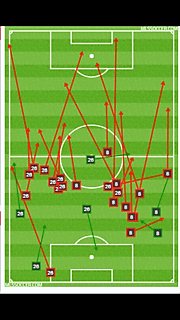
The chart at the head of this piece is the passing map of the two central defenders on the day, Tim Parker and Andrew Jacobson.

Parker managed to compile a somewhat remarkable 26.7% pass completion rate while Jacobson exceeded even that figure with a law of averages defying 16.7%.

And, as you can see, they just about managed to complete one succesful pass into the opposition half.

Not that it wasn’t for the want of trying though as they each launched a number of high balls forward to the rather small Fredy Montero and the ill-equipped for the role Brek Shea.

Hard to say why that tactic didn’t work, but might it be because Montero is rather small and Shea is ill-equipped for the role?

If it was Carl Robinson’s plan to make use of this kind of distribution then it clearly failed miserably.

But maybe that wasn’t the plan (Let’s really hope it wasn’t the plan) and it was ultimately the circumstances on the day which lured Parker and Jacobson into personifying the definition of hope over experience?

After all, the options open to them were limited.

Not since Pedro Morales departed have the Whitecaps had a player who could comfortably drop back and pick the ball up from the back four in the hope of launching a legitimate attack.

Christian Bolaños can fill the role but he is currently injured and even if he were fit forcing him into that position removes him from the wide areas where he is at his most dangerous.

So Jacobson and Parker were left with Laba and Tchani as their main outlet.

Laba picked the ball up deep seven times and on six of those occasions (Six!) he gave the ball away.

Tchani picked the ball up just once from either of the central defenders during the entire game (In fairness to Tchani his passing accuracy was off the scale compared to almost all other members of the team) but he clearly wasn’t tasked or asked to be the conduit between the defence and the midfield.

So what about the fullbacks?

Well, Tim Parker successfully passed the ball to Jordan Harvey once and er…that’s it.

Throw into the mix the fact that David Ousted distributed the ball twelve times and only on three of those occasions was it within his own half and either by accident or design the Whitecaps became a team simply lumping long balls forward to two players who don’t like to play in that kind of way.

I could probably add the overall lack of team movement (Which also seems to be a feature of Robinson’s coaching style) as yet another factor to throw into the mix explaining the inability to keep the ball because a Whitecaps player in possession rarely has the option of more than one teammate to pick out, thus making it so much easier for the opponent to press and close them down.

Lots of reasons then as to why Vancouver failed to keep hold of the damned thing on Saturday, but not so many answers as to how or if the coaching staff will address those issues in either the immediate or long-term future.

Safe to say though that a 26% possession return in Chicago this coming Saturday would almost certainly be a recipe for disaster.