Vancouver Whitecaps passing passeth all understanding

Of all the stats that now bounce around soccer as chaotically as a ball at a Whitecaps training session there is perhaps none to have undergone such a change of perception as that of “possession”.

In the heyday of the peak Tiki Taka period of Barcelona and Spain high possession percentages were presented with all the reverence of a Springsteen cover band tentatively striking the opening chords of Born to Run.

Then over time the pendulum swung towards the Mourinhoesque view that possession, if not inherently dangerous, did at least offer more opportunities to those teams without the ball than those with.

Nowadays those possession stats have become so ubiquitous they just seem to serve the purpose of whoever is opining about whichever game. Team won with low possession stats? Possession doesn’t mean anything. Team won while dominating possession? The numbers don’t lie.

Under Carl Robinson the Vancouver Whitecaps have almost always edged toward the negative side of the ledger when it comes to being in control of the ball but a few recent games (And in particular the recent 2-2 tie in Minnesota) have taken those deficits to a fairly astonishing level.

Against the expansion team Vancouver managed to retain the ball for only 26% of the time and remarkably there wasn’t a single five-minute period in the whole game in which they out-possessed Minnesota.

There are two possible explanations for this failing; the first is that it was a feature of the tactical plan, the second is that it was a bug.

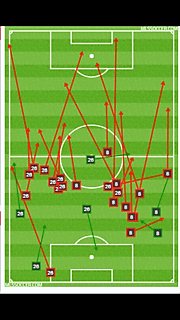
The chart at the head of this piece is the passing map of the two central defenders on the day, Tim Parker and Andrew Jacobson.

Parker managed to compile a somewhat remarkable 26.7% pass completion rate while Jacobson exceeded even that figure with a law of averages defying 16.7%.

And, as you can see, they just about managed to complete one succesful pass into the opposition half.

Not that it wasn’t for the want of trying though as they each launched a number of high balls forward to the rather small Fredy Montero and the ill-equipped for the role Brek Shea.

Hard to say why that tactic didn’t work, but might it be because Montero is rather small and Shea is ill-equipped for the role?

If it was Carl Robinson’s plan to make use of this kind of distribution then it clearly failed miserably.

But maybe that wasn’t the plan (Let’s really hope it wasn’t the plan) and it was ultimately the circumstances on the day which lured Parker and Jacobson into personifying the definition of hope over experience?

After all, the options open to them were limited.

Not since Pedro Morales departed have the Whitecaps had a player who could comfortably drop back and pick the ball up from the back four in the hope of launching a legitimate attack.

Christian Bolaños can fill the role but he is currently injured and even if he were fit forcing him into that position removes him from the wide areas where he is at his most dangerous.

So Jacobson and Parker were left with Laba and Tchani as their main outlet.

Laba picked the ball up deep seven times and on six of those occasions (Six!) he gave the ball away.

Tchani picked the ball up just once from either of the central defenders during the entire game (In fairness to Tchani his passing accuracy was off the scale compared to almost all other members of the team) but he clearly wasn’t tasked or asked to be the conduit between the defence and the midfield.

So what about the fullbacks?

Well, Tim Parker successfully passed the ball to Jordan Harvey once and er…that’s it.

Throw into the mix the fact that David Ousted distributed the ball twelve times and only on three of those occasions was it within his own half and either by accident or design the Whitecaps became a team simply lumping long balls forward to two players who don’t like to play in that kind of way.

I could probably add the overall lack of team movement (Which also seems to be a feature of Robinson’s coaching style) as yet another factor to throw into the mix explaining the inability to keep the ball because a Whitecaps player in possession rarely has the option of more than one teammate to pick out, thus making it so much easier for the opponent to press and close them down.

Lots of reasons then as to why Vancouver failed to keep hold of the damned thing on Saturday, but not so many answers as to how or if the coaching staff will address those issues in either the immediate or long-term future.

Safe to say though that a 26% possession return in Chicago this coming Saturday would almost certainly be a recipe for disaster.
 

Vancouver Whitecaps: Something we learned yesterday

The Vancouver Whitecaps 2-0 half time lead over Minnesota United on Saturday evening wasn’t so much a vindication of Carl Robinson’s switch to 4-4-2 as it was a statistical anomaly caused by a penalty kick and another set piece goal.

A better coach (Or even a more proactive one) would have cashed in his chips at the break and reverted to the 4-1-4-1 system that has served the team well in recent weeks.

That didn’t happen though and the home team came out with something to prove and levelled the game with relative ease.

Fortunately that seemed to be the limit of their ambition and from that moment on the game felt like two broken down boxers taking half-hearted swings, each more concerned with feeling the mind numbing force of the knockout punch than landing it.

I’m not sure what it will take for Robinson to realise that Brek Shea is unable to play the central attacking role effectively, but Brek Shea constantly being unable to play the central attacking role effectively doesn’t seem to be it.

Against Minnesota he and Fredy Montero weren’t so much supporting each other as drifting in orbits dictated by a differing gravitational pull.

And though it’s good that the team are now so effective from set-pieces sooner or later they will have to figure out how to give Montero some actual service or risk turning their Designated Player into yet another journeyman forward scampering for space where none can be found.

Elsewhere Alphonso Davies provided a modicum of momentum when he was on the ball and Tony Tchani finally produced a goal without ever offering much of an attacking presence from the middle of the field.

And the makeshift defence did what we expected it to do; be largely solid while always hinting at the possibility of conceding when under genuine pressure.

Whether we see this game as two points dropped after being 2-0 up against one of the League’s less impressive teams or a point gained on the road during an injury crisis will largely depend on the tale of the table at the end of the year.

But next week’s trip to Chicago and the following home game against New York City will be much tougher tests than the one faced on Saturday and just doing enough to get by won’t be doing enough against either of those opponents.

Injuries and suspensions are no doubt a cause of much of the malaise but those injuries and suspensions seem to be tempting Carl Robinson back to the comforting cloak of safety first football that he looked to have discarded earlier in the season.

Let’s hope not.

Time for the Soccer Shorts Player Ratings.

Ousted-6, Nerwisnki-6, Parker-6, Jacobson-6, Harvey-6, Laba-6, Tchani-6, Davies-6.5*, Techera-6, Shea-5.5, Montero-6


VAR from the Madding crowd

We all want certainty in our lives.

As we fight through the maelstrom of the modern world we become increasingly desperate for something, anything, to cling on to.

Just one solitary thing we can know without having to grapple with the uncertainties of subjectivity or moral relativism. A line in the sand that, once drawn, can never be breached or obliterated.

A moment when we can say without fear or fuss that a thing is true. Definitively, certifiably true.

Which is probably why the Video Assistant Referee (VAR) is being introduced into football.

Well, it’s either the search for clarity in a fragile world or the numerous sponsorship opportunities and lucrative contracts that the innovation creates.

Hard to choose between the two really.

I’ve always been very much in the anti VAR crowd so don’t expect anything approaching objectivity here, but a few games into the Confederations Cup have done little to quell my unease.

So let’s look at a few of the issues the current “test” raises.

“It’s only a test”– If somebody taking their driving test smashes into a shop window while texting their mother with their feet they don’t get to say “But it’s only a test! You can’t fail me for that!”.

Yet VAR seems to have that out every time. Players should have been red carded but weren’t? “It’s a test!”. Acres of time spent making a decision that is usually made instantly? “It’s a test!”.

We all know it isn’t really a test of course. There’s no way the authorities will have invested this much time, money and free lunches for it to fail now.

But if there’s any time for genuine criticism of the system then that time is now. None of this “It’s a test!” nonsense anymore please.

The effect on referees”- Most of us are used to driving with a GPS by now (Another driving metaphor? Weird) and we all know how that changes the way we perceive the world.

We pay less attention to our surroundings because we really don’t need to be looking for that church we need to turn left at because the GPS will tell us.

I’m not sure if that makes us worse drivers than before but it definitely makes us different drivers.

And I’m equally not sure that the match official in the Mexico v New Zealand game which descended into a brawl in the Confederations Cup would have acted any differently had there not been VAR

But it definitely felt as though he was willing to abrogate responsibility to the voices in his ear.

Over time that would very much change the way a game is officiated and I’ll leave it to you to decide if having a referee less mentally connected to the action is a good or bad thing.

It doesn’t eliminate controversy  One of the main selling points for the system was that it would eradicate endless debates about goal decisions, penalty calls and red cards.

The limited evidence so far is that it does no such thing.

That really shouldn’t be a surprise when the instances of “I’m seen them given” penalties are so numerous in football but for some reason there was the assumption that somebody looking at a replay seconds after the actual incident had occurred would be able to achieve a the kind of omnipotence only the gods can usually lay claim to.

So VAR won’t reduce arguments about the game at all, but it will at least make them far more tedious.

The law of unintended consequence VAR proponents were thrilled when a Portuguese  goal was recently rescinded because Pepe was shown to be a sliver of shoe offside.

“See!” they said “That worked!”.

And indeed it did. But what will be the eventual repercussion of that kind of decision?

For one thing I doubt that Assistant Referees will be raising their flags for marginal offside calls for much longer.

Why would they? Get it wrong and the tape will show that they stopped a legitimate goal scoring opportunity.

But if it was offside and a goal is scored it can always be reviewed. And if it was offside and no goal is scored then there’s no harm done right?

But what if it was offside and the subsequent attack leads to a corner which then leads to a goal?

Do we go back and review the offside call? You bet we will once something like that happens to a Real Madrid or a Manchester United in a big game.

And what if the corner was given incorrectly anyway? Review that if it leads to a goal? Same answer as above.

In short, a system that was originally promoted as only intervening in the most crucial of decisions is already displaying the kind of mission creep that makes most American inerventions in the Middle East look like well planned military exercises.

The MLS version is even worse- Getting the match official to trot over to a TV screen on the side of the pitch to review an incident should prove to be a bizarre mix of technology and farce.

At least it will provide a few laughs during the longueurs of waiting for an actual decision to be made I suppose.

Roll on August.


Vancouver Whitecaps: We Better Talk This Over

One of the many reasons why Bob Dylan is the greatest songwriter of the modern era is that, despite being hailed as a genius and the “voice of his generation” for at least fifty years, he has somehow been able to maintain a sense of his own fallibility within his lyrics.

Be it the “You’re right from your side and I’m right from mine” of 1963’s One Too Many Mornings, the “So many things we never will undo, I know you’re sorry, I’m sorry too” from 2001’s Mississippi or “Maybe it’s the same for me as it is for you” from 2012’s Long and Wasted Years.

Even at the end of one of his most bitter songs (1975’s Idiot Wind) after ten minutes of berating the partner in a failing relationship he concludes by accepting his own culpability in all that’s gone wrong; “We’re idiots babe, it’s a wonder we can even feed ourselves”.

There’s little doubt that Dylan hasn’t lived up to these lofty ideals throughout his entire personal life but that doesn’t make the sentiment any less valid (“Never trust the artist. Trust the tale” as D.H. Lawrence would have it) and anyway, rock stars get a pretty clear pass when it comes to the “being a role model” part of the job.

Excess and imperfection are not so much tolerated as expected in guitar heroes and modern day minstrels.

That leeway doesn’t apply to sporting figures however and it’s not quite clear why that is.

Maybe because they represent athletic achievement? Maybe because we often celebrate that achievement with our families and friends? Maybe because we feel we know them far more than we really do after watching them play week in and week out and listening to sound bite interviews?

Whatever the reason that sense of personal connection paradoxically makes us feel the pain of any supposed betrayal more keenly while simultaneously making us more eager to forgive and move on from any hint of indiscretion.

It’s a complicated set of emotions stemming from a weekly diversion that we ultimately want to be simple. We want “our” guys to be the “good” guys and we want “their” guys to be the “bad” guys and when the narrative doesn’t quite slot into that simple little niche we feel strangely bereft of any true moral compass.

And we tend to feel even more bereft when the facts surrounding a situation are (rightly) kept from public view, leaving us to clutch at innuendo and intuition as we clamber for some kind of ethical foothold to keep us upright.

We all still have our opinions of course (it almost feels like a facet of human nature to take sides in any situation).

But time and circumstance will cause those opinions to either harden or melt as the weeks and months go by until we finally lose track of what we knew we knew to be true way back when.

The only thing we can say with any certainty is that football is a simple game played by people who are just as complicated as you and I.


Good Times Bad Times for the Vancouver Whitecaps

Given that the Vancouver whitecaps were without three of their more impressive players of the season thus far in Waston, Bolaños and Williams the 1-1 tie with FC Dallas on Saturday evening was a satisfactory result.

It was even more satisfactory given how the game played out on the night as the Whitecaps created virtually nothing from open play and were once again forced  to rely on a set-piece to get them out of trouble.

Given all the absences Carl Robinson opted to move Andrew Jacobson into central defence and make Russell Teibert Jacobson’s replacement in the middle.

That was the most logical move in theory but in practice it didn’t really work out.

Jacobson was at least partly responsible for the Dallas goal and the team’s attacking options were effectively neutered as Teibert barely approached the opposition penalty area and when Tony Tchani did get an opportunity to play a dangerous pass he failed miserably.

It’s hard to know if that failure was down to technique or a mental block but either way Tchani’s progress in that role took a step back this week.

Things only really changed with the introduction of Alphonso Davies for Teibert as the youngster at least displayed a willingness to run at Dallas through the centre of the field.

It was only a cameo appearance for Davies but it could be that the central midfield suits him best in a team with a surplus of wide players. The Whitecaps certainly need somebody in there whose first thought is to get forward rather than to turn back.

Elsewhere Brek Shea filled in well for Bolaños without getting near his creativity and Jake Nerwinski did a steady job at right back without offering the attacking threat his pace can provide.

Vancouver now move on to two road games in struggling Minnesota and not struggling Chicago and it could be that the coach liked what he saw from that lineup when it came to defensive solidity.

Let’s hope not though.

The Whitecaps have prospered this season when they have shown initiative and a willingness to take the game to the opposition, but in times of trouble we all tend to revert to whatever our personal default position happens to be and there’s little doubt that Robinson’s is “safety first”.

Although “safety first” when it comes to players getting injured might not be a bad mantra for the rest of the season.

Time for the Soccer Shorts player ratings.

Ousted-6, Newinski-6, Parker-6.5, Jacobson-6, Harvey-6, Laba-7*, Teibert-5.5, Tchani-5.5, techera-6, Shea-6.5, Montero-6 (Davies 6.5)


Vancouver Whitecaps: The Season So Far (The Forwards)

The female mosquito has six separate needles with which to extract our blood.

Two that are used to saw through the skin, two to hold that skin apart, one to drip saliva into the blood to keep it flowing and finally one to act as both a straw and a filtration system that separates the water from our blood and immediately excrete it; thus allowing as much top quality red blood cells as possible to be ingested.

We can say two thing about this.

Firstly, since it is sucking our blood while urinating on us the mosquito is a perfect metaphor for modern capitalism.

Secondly, we can only wish the Vancouver Whitecaps had such an efficient system for cutting through any kind of defence.

At least things haven’t been quite as bad this season and so we can conclude our ratings of the players so far with a cursory glance at the forwards.

Fredy Montero- 6.5 There must have been time earlier in the season when Montero felt as though the three attacking players consisted solely of Him, Himself and He.

Things have improved as the year has developed with both the wings and even the central midfield offering support on an almost regular basis.

The most positive thing about Montero has been the amount of work he puts in to every game. After all, the highest paid player could well have fallen into an extended sulk at not having the whole game plan revolve around him but Montero has never let his frustration show for more than a fleeting moment.

There have even been times when he’s effectively been playing both the number ten and the number nine role and that probably explains his slightly disappointing return in terms of goals scored but it’s inconceivable to imagine Vancouver being anywhere near as effective if Montero was absent for any length of time.

Brek Shea-6.5 Shea is a bit of an odd duck. There are times when he displays the qualities of the Premier League player he was for a few years and then there are times when he reacts to being given the ball with the same sense of alarm and despair I display when handed the bill at the end of a hearty meal with friends.

Shea hasn’t been helped by being played out of position in the central attacking role and nor has he been helped by injuries, suspensions and the good form of those currently ahead of him in the pecking order.

The optimistic view (And probably the right one) is that there is still much more to come from a player who should display fewer red card inducing fits of pique as he gets nearer to peak fitness.

Nicolas Mezquida-6.5 We have enough of a sample size to know that Carl Robinson doesn’t regard Mezquida as a regular starter and the coach may just be right about that.

Mezquida certainly doesn’t fit comfortably into the current formation for example.

There are times though when it feels as though he’s the last option to be considered from the bench when a game is crying out for his input.

Mezquida excels in both defending from the front and creating chances out of nothing through the sheer persistence of his pressing of defenders.

What he offers is the opportunity to move to two central forwards without losing too much of the defensive solidity through the middle and although he doesn’t have the most exquisite of touches he at least appreciates where the ball should be played and which runs should be made (Naming no names here).

He’s out of action for a few weeks so this is moot at the moment but if there was a trophy for “Most underappreciated by the coach and most overappreciated by the fans” (Let’s call it the MUBTCAMOBTF Trophy for the sake of simplicity)  then Mezquida would win it hands down.

Kyle Greig- 6  The only other forward to get any kind of meaningful minutes of first team action is Greig who looks a little too slow and a little heavy of touch to make it at the MLS level but does at least offer the possibility of being the “big man up front” for a desperate final five minute push for an equalizer.

It’s certainly better to have him playing that role than trying to force the ill-equipped Shea to do so anyway.

So there we have it.

Like the midfield the forward line has improved in 2017 (Though maybe not quite as much).

And like the defence the midfield has improved in 2017 (Though maybe not quite as much).

Next time out I predict there will be an actual game of football to talk about.


Whitecaps find joy looking for Atlanta’s weakness

Atlanta United arrived in town with quite the reputation.

“They won’t just sit back and defend” people said. ‘They play a fast passing game” people said. “They will press the back line” people said.

Well, it turns out that people were right and, for the first fifteen or twenty minutes, it seemed as though all of those things would be too much for the Vancouver Whitecaps as the visitors stormed into an early lead and offered the prospect of adding more every time they moved forward.

Gradually though the tide began to change and whether that was a result of Vancouver slowly finding their feet or simply the limitations imposed by the structure of any MLS team is a moot point.

We do know that Matias Laba began to close down more effectively, that the back four finally found their shape and that Andrew Jacobson (who was excellent yet again) and Tony Tchani (who had his best game as a Whitecap) began to not only block up the centre of the field but also began to offer something going forward.

One of the benefits of the 4-1-4-1 system is that Carl Robinson has finally figured out how to get the midfield to act as a conduit between the back line and the forwards and while neither Tchani or Jacobson will ever be in the highest cohort of creative midfielders they served that function well on Saturday.

In the end it was set pieces that did for Atlanta with Kendall Waston scoring two and Fredy Montero getting a much needed end to his goal drought by doing what every good striker does and stealing a perfectly legitimate strike away from Tim Parker.

That was just one of two moments of high quality comedy that this game provided.

Parker and Waston obliviously celebrating scoring a goal while the rest of the game carried on around them was just great, but the highlight was when referee Robert Sibiga saw Fredy Montero fouled in the box and immediately awarded a penalty kick.

The only problem with that decision was that Montero was back defending a corner and the penalty kick had been given to Atlanta.

Turned out the ref had forgotten which way the Whitecaps were shooting!

He fixed the problem with alacrity however so all was good.

The Whitecaps now have a week off and they go into that break having given arguably their best performance of the season.

They dealt with the body blow of an early goal with stoicism, they played to their strengths against an opponent they would have been dismantled by last season and they dominated the second half by always looking to push forward to add to their advantage.

All in all it was a thoroughly enjoyable game of football.

Time for the Soccer Shorts player ratings.

Ousted-6.5, Harvey-6.5, Williams-6.5, Waston-7, Parker-7, Laba-7, Tchani-6.5, Jacobson-7*, Bolaños-6.5, Techera-7, Montero-6.5 

Carl Robinson and the Shadow of Forgotten Ancestors

“If you wish to make an apple pie from scratch, you must first invent the universe.”

-Carl Sagan

How does genuine change occur?

Well, one way is by seeing the past as not so much a template for what is to be and more as one specific instance to have played itself out from a multitude of possibilities.

What’s happened may indeed have happened but that doesn’t mean that it had to happen and it certainly doesn’t mean that the future can only be defined in the narrow terms imposed by what has been.

(You will soon be able to sign up for my weekly newsletter “Random phrases that seem quite deep but really mean nothing upon closer analysis)”. 

Anyway, this is a very all around the houses way of saying that whatever anybody may have thought of him before the Whitecaps coach Carl Robinson has displayed a somewhat remarkable degree of tactical flexibility this season.

Gone is the rigid belief (and fear) of the power of the first goal and gone too is the stubborn adherence to 4-2-3-1.

It’s only May in 2017 and Robinson has already trotted out a greater varieties of tactics than he did in all the previous years of his tenure.

It’s true that this doesn’t always feel like the perfect fit for his (football) personality and there’s still the sense of a man desperately trying to come to terms with a belief system that he doesn’t quite buy into.

No coach who genuinely believed in pure attacking football would leave Fredy Montero quite so isolated for example, but it’s also true that often the most zealous adherents to any faith are those who have converted late in life.

So the long awaited return/debut of Jordy Reyna and even the moment when Bernie Ibini is fully match fit may see the coach push the envelope even further and deploy two forwards in the same starting eleven.

The biggest problem he faces is that the squad he has assembled just doesn’t seem to have either a natural starting eleven or even a natural starting formation.

There’s no way that Bolaños, Shea, Davies, Techera, Tchani, Reyna, Montero et al can all fit into a lineup that makes any kind of sense and while the argument for depth is always a persuasive one there exists the distinct risk that Robinson will confuse adaptability with fitting square pegs into round holes once he has a full roster to choose from.

So perhaps the biggest change that needs to occur (And there have already been signs of this in both the Manneh trade and one or two of his post game comments) is that he moves further and further away from being the players friend and closer and closer to being their manager.

It seems harsh to say that a coach is too involved with his team but following the terrible penalty call against DC United on Saturday it seemed as though Robinson lost his focus on the game for maybe ten to fifteen minutes.

Now I get why that should be because we all probably reacted in the exact same way, but that was the moment when his players really needed a clear head from the sidelines.

There was still plenty of time (And plenty of chances) to go but it could be that the Whitecaps lost a few valuable minutes because there was nobody on or off the field who could gather their collective heads together.

By this stage of this ramble it kind of feels as though I’m damning the coach with faint praise but that’s genuinely not the case.

It’s far more interesting to watch a team coached by a man who is willing to take chances than one who always adopts the safety first approach and the next two games will be a little tactical adventure in and of themselves.

First Robinson has to select a group of players capable of coming away with at least a tie in Montreal on Tuesday without damaging his team’s chances against Atlanta on Saturday.

And the Atlanta game should be fascinating.

They play the kind of high pressing game that, on one hand, could be catnip to a Vancouver team who must be sick of opponents sitting back at BC Place but, on the other hand, that high pressing game could be kryptonite to a Vancouver back four who regard any pass longer than five yards as more of an aspiration than an attainable goal.

But how Robinson must be relishing pitting his wits against “Tata” Martino (Ex Barcelona and Argentina coach).

In the past the Whitecaps would treat this visit with caution and simply sit back waiting to see who made the first mistake.

But now there’s a chance (There’s at least a chance!) that Robinson will try something fresh yet again and that would be (Has to be) a very good thing indeed.

Time for him to invent yet another new universe!

Vancouver Whitecaps rue everything!

It’s hard to know what to make of the Vancouver Whitecaps 1-0 defeat to DC United at BC Place on Saturday afternoon.

After all, on another day the Whitecaps could easily have won by two or three goals; they missed a spot kick, hit the woodwork four times and lost to an extremely dubious penalty call.

So was it just “one of those games”?

It probably was, although the lingering feeling that Vancouver have had “one of those games” quite a number of times over recent seasons might leave a person of a more worrisome disposition to consider it a trend rather than an anomaly.

Weak opposition sit back while the Whitecaps huff and puff with effort but no success.

And that lack of success in this particular game was down to a number of factors beyond the vagaries of the mythical “Soccer Gods”.

Christian Bolaños never quite found his passing range (Nobody else did either but Bolaños is key in this kind of game), Fredy Montero was a little less isolated but also a little less confident in front of goal than a top striker needs to be and Davies and Techera created next to nothing from the wide areas.

The fact that three of the Whitecaps four cracks against the woodwork came from set pieces also tells at least some of the story and even the chances that were created from open play were far more the result of a stray bounce here and and a mishit shot there than the well orchestrated and crisp passing we saw against Kansas last week.

That’s just the vagaries of MLS I suppose, but the Whitecaps have now taken one point from the three Eastern Conference teams to have played at BC Place this season and with the West being so close that they currently sit both out of the playoff places and only six points off the top with two games in hand those dropped points could be season changers come the end of the campaign.

The return of Matias Laba next week probably means a return to the 4-1-4-1 that has worked so well in recent weeks but it’s clear that this team is still a work in progress with Carl Robinson having to figure out how to fit his best pieces into his best eleven.

Bolaños is better suited to playing in the wide role, especially in a game as congested as this one was, and Alphonso Davies still looks more dangerous as a substitute than a starter and while Tony Tchani was a little bit better once again he’s still not offering enough going forward (Both in terms of quantity and quality).

These uncertainties are probably no bad thing given the way the season is structured but let’s hope the coach doesn’t allow a bad refereeing decision and the framework of a goal to persuade him that all is well within his team because if a dodgy penalty costs you the game at home to a poor DC United team then there’s still plenty of work to be done.

Time for the Soccer Shorts player ratings.

Ousted-6, Williams-6.5, Harvey-6.5, Parker-6.5, Waston-6.5, Jacobson-6.5*, Bolaños-6, Techera-5.5, Davies, 5.5, Tchani-6, Montero-5.5


Game of two halves for Schrödinger’s Caps

There aren’t really any “must win” games at this stage of the Major League Soccer season but the Vancouver Whitecaps home game to Sporting Kansas City at least felt like an “it would be really, really, nice to win” game.

Following up a positive four game road trip with a flat and futile performance at BC Place wold have felt like a step back in a season that had lurched toward the positive in recent weeks.

The end result was a comfortable 2-0 win for the Whitecaps but for the first thirty minutes “flat and futile” felt like a pretty good description of the game.

Coach Carl Robinson announced an unchanged team for the fifth consecutive game and he can’t really have been surprised to discover that a lineup which was very effective on the road proceeded to produce yet another effective road performance with few chances given or taken.

That really isn’t good enough for a home game though but, just when it appeared that the Whitecaps had lapsed into relying on hopeful/hopeless long balls from Kendall Waston to fashion any kind of chance the big central defender produced a decent pass to Sheanon Williams who hit a great cross to Christian Bolaños who chested it down to Cristian Techera who volleyed home first time.

It was a goal of genuine class in a half that was largely bereft of that particular commodity.

Thankfully the second half was far better and whether that was down to Kansas being forced to push forward and leave space at the back or whether it was down to Vancouver being more adventurous is open to debate but chance after chance was spurned (Including another Montero penalty miss) before Tim Parker headed home a Bolaños free-kick to all but seal the deal.

The question now for Robinson is how he sets the team up for the game against DC United next saturday.

Tony Tchani is still struggling to find a role in the side and the balance looked far better once he was removed and Alphonso Davies pushed wide and Bolaños moved inside.

Let’s call that a 4-1-1-3-1 for now with Jacobson being the second ‘1’ and playing the role of the Schrödinger midfielder; vacillating as he did between attack and defence.

That certainly feels more like the way forward than what we saw at the start of the game and it would also offer up an easy way to get both Brek Shea and the in form Techera into the starting eleven.

Will Carl Robinson continue in his great adventure toward tactical flexibility? This game should have convinced him that he needs to do just that but, for now, we can all enjoy three valuable points and a long and sunny holiday weekend.

Time for the Soccer Shorts player ratings.

Ousted-6, Williams-7, Parker-6.5, Waston-6, Harvey-6.5, Laba-6.5, Jacobson-6, Tchani-5.5, Techera-6.5, Bolaños -7*, Montero-5.5